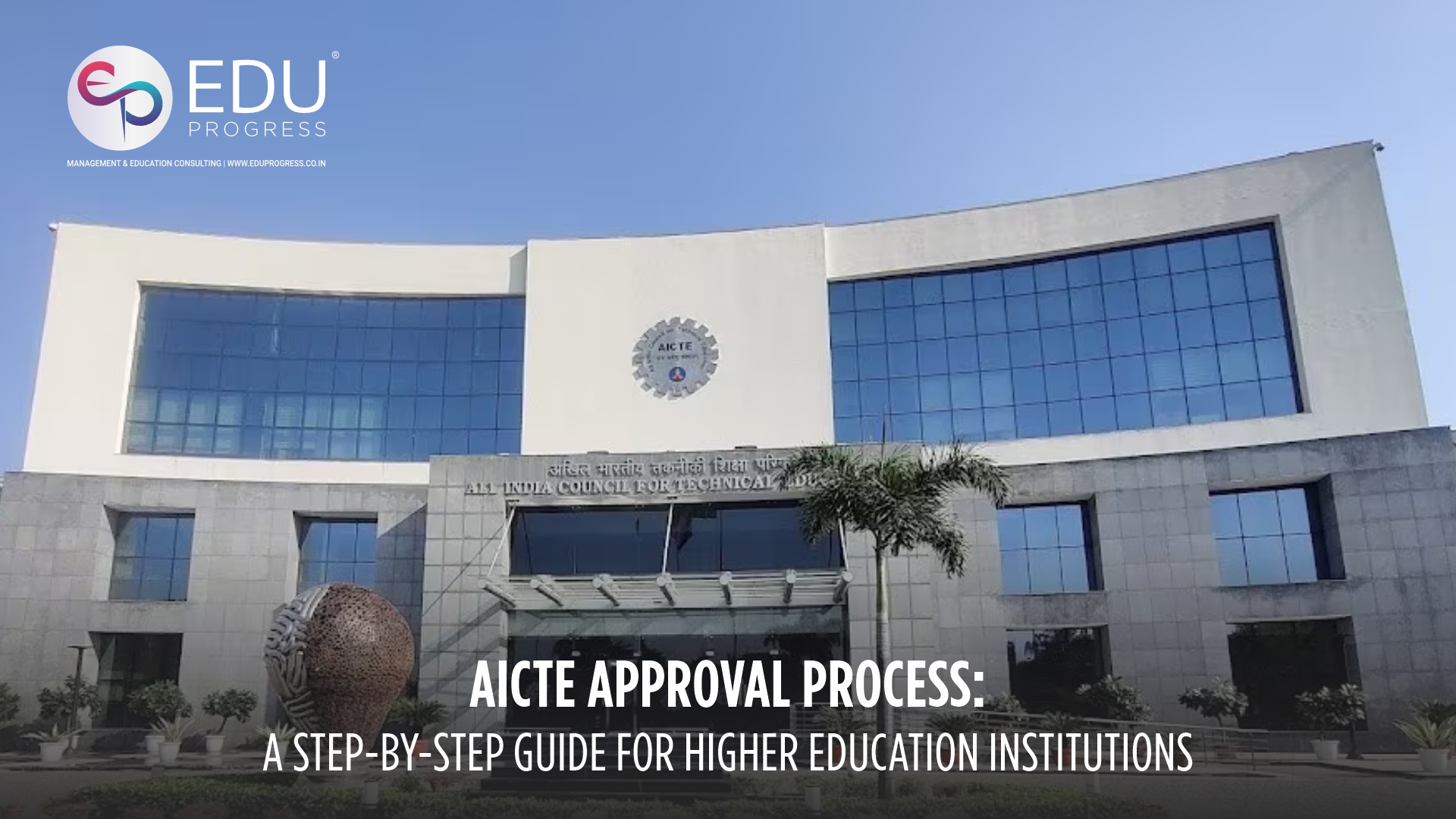
AICTE Approval Process:
A Step-by-Step Guide for Higher Education Institutions
Introduction
Securing AICTE approval is the most crucial step for institutions planning to offer technical and professional educational programmes in India. AICTE helps institutions with accreditation and regulatory frameworks to maintain the quality of education. It plays a vital role in India’s academic framework, maintaining standards in teaching, infrastructure, research, innovation, and overall institutional functioning.
This blog provides a step-by-step guide to the AICTE approval process, supporting institutional leaders and managers in understanding the process – what’s required, how to prepare, and how to avoid common pitfalls that delay or derail approvals.
What Is AICTE Approval & Its Role in Higher Education?
The All India Council for Technical Education (AICTE) is a statutory body responsible for regulating technical and professional education in India. AICTE approval for new institutes and existing ones validates that institutions meet quality standards for infrastructure, faculty, governance, safety compliance and academic offerings.
AICTE supports institutions with a progressive approach that helps them function efficiently and effectively. It ensures institutions comply with industry standards, facilitating student learning through curriculum improvements, innovation and the adoption of digital learning. For new and existing institutes, it is a critical step towards long-term recognition and sustainability.
Step-by-Step AICTE Approval Process
1. Pre-Application Requirements
Before beginning with AICTE’s Approval for Institutes online application, the institutes must ensure they meet the eligibility criteria outlined in the AICTE’s approval handbook. Key requirements include:
- Land & Building Readiness: The land must have clear ownership proof documents, mutation certificates, and approved building plans.
- Trust/Society Registration: Valid registration documents of your trust/society, audited financial statements, and governing body structure are mandatory.
- Infrastructure Planning: All infrastructure planning must align with AICTE norms, including classroom sizes, laboratories, library resources, equipment lists, and safety installations.
- Faculty Requirement Planning: Proposed faculty lists must reflect qualification norms and subject expertise in line with the academic offerings.
- Pre-Audit Checklist: Institutions should review compliance related to safety standards, environmental norms, accessibility, building stability, and documentation before the audit.
2. Registration on the AICTE Portal / NSWS
New institutions must register on either the AICTE portal or the National Single Window System (NSWS). The process includes:
- Creating an institutional profile with trust/society details
- Adding basic required infrastructure and land information
- Navigating and checking mandatory fields carefully
- Uploading clear and legible documents in the required formats
Accuracy at this stage prevents technical errors and delays during verification.
3. Filling the Application
This step involves entering detailed information about:
- Institution, trust/society, and management
- Land area, ownership, and approved building plans
- Proposed academic programmes
- Teaching-learning infrastructure, safety systems, and library resources
Institutes must upload supporting documents, such as land records, faculty profiles, building photographs, academic calendars, and equipment lists, to complete the application without errors.
Common mistakes to avoid while filling out the application:
- Mismatched information between land records and uploaded documents
- Missing signatures or stamps on approvals
- Incomplete or outdated faculty data
- Uploading unclear or low-resolution files
All of this can lead to the rejection or failure of the application. Institutions must conduct a final internal check before submission to ensure all documents are valid and accurate.
4. Submission & Fees Payment
After reviewing the application and documents, the next step is to pay the submission fee, which includes:
- Verifying every detail entered in the application forms.
- Downloading and securely storing all submitted forms (Part 1 and Part 2 ).
- Ensuring the successful payment of the TER fee, as mentioned in the form.
- Avoiding last-minute submissions that risk errors or portal timeouts.
All specific fee breakdowns for institutions and programmes are provided in the AICTE’s approval process handbook.
5. Site Inspection & Verification
Once the application has been successfully processed, the AICTE appoints an Expert Visit Committee (EVC) to inspect the institution’s physical infrastructure and other institutional frameworks to evaluate the institution for AICTE’s approval.
The EVC shall verify physically/ online the infrastructural facilities of the institution.
It includes evaluation of:
- Academic and administrative infrastructure
- Classroom size and seating capacity
- Laboratory equipment and utilisation
- Safety systems: fire, electrical, CCTV, anti-ragging measures
- Faculty list validation and availability
- Library resources and digital learning tools
- Accessibility and sanitation facilities
After thoroughly evaluating the institution, the EVC committee prepares the audit document, highlighting areas for improvement and issues, and providing comprehensive audit insights.
6. Approval Decision
Post-inspection, AICTE reviews the report and issues an approval list for new institutions, existing institutions, and institutions that have applied for the extension of approval (EoA).
Common Challenges Institutions Face
- Missing land or building documentation
- Insufficient built-up area compared to standards
- Shortage of qualified faculty members
- Incomplete equipment purchase bills
- Missing safety certification
- Errors during the online portal submission process
- Lack of preparation during inspection
Understanding these challenges early helps institutions plan proactively and avoid avoidable delays.
Best Practices & Expert Tips from Eduprogress
- Conduct a complete compliance audit before filling out the application form.
- Digitise all documentation, keep all documents clear, stamped, and handy.
- Prepare faculty plans aligned with programme intake and AICTE norms.
- Use structured SOPs for inspection day, including supporting documents, facility walkthroughs, document counters, compliance files and other essentials & desirable requirements as per the Approval Process Handbook.
- Respond to deficiencies quickly with accurate supporting evidence.
- Use consultancy support to minimise errors, avoid rejections, and ensure timely approval.
Eduprogress provides end-to-end support, helping institutions navigate the process with clarity and confidence, meet every compliance requirement with ease, and obtain approval successfully.
Key Highlights from the Latest AICTE Approval Process Handbook
AICTE’s latest handbook includes all the norms and requirements for institutions to ensure a simplified approval process. It includes:
- Clear AICTE rules and regulations for new institutions, extension of approval (EoA), closure and hibernation.
- Simplified norms for compliant institutions
- Updated guidelines for land and infrastructure
- Details about greater academic flexibility
- Provisions for new-age programmes in emerging technologies
- Emphasis on digital record-keeping systems, safety norms and quality assurance
- Clear, structured information about payments and fees for each application process.
To remain informed about the latest updates and approval status, institutions need to check the AICTE portal.
Conclusion
AICTE’s approval is a mandate for institutions aiming to build a strong academic foundation and deliver quality technical education. It represents a long-term commitment for institutions to scale with credibility and academic excellence.
It helps institutions create an atmosphere that supports technical education across engineering programs (such as B.Tech in Artificial Intelligence and Machine Learning Engineering, B.Tech in Computer Science and Engineering, etc.), IT, healthcare, and vocational training, with well-planned infrastructure, digitalisation, and facilities.
At Eduprogress, we support institutions at every step, from eligibility assessment to documentation and inspection preparation. With our strategic support and expert guidance, we assist institutions in meeting AICTE’s compliance without any delay or uncertainty.
Secure your AICTE’s approval with clarity and confidence! Partner with Eduprogress!
FAQ
Q1. What is AICTE approval and why is it required?
AICTE (All India Council for Technical Education) approval is a statutory validation confirming that an institution meets prescribed standards for infrastructure, faculty, governance, and safety before it can offer technical or professional programmes in India.
Q2. What documents and readiness checks are needed before applying?
Institutions need clear land ownership and building plan documents, valid trust or society registration with audited financial statements, infrastructure as per AICTE norms, a qualified faculty plan, and a completed pre-audit compliance checklist.
Q3. Where do institutions register to start the AICTE approval process?
New institutions register on the AICTE portal or the National Single Window System (NSWS), creating an institutional profile and uploading required land, infrastructure, and trust/society details.
Q4. What happens during the site inspection stage?
AICTE appoints an Expert Visit Committee (EVC) to physically or virtually verify infrastructure, classrooms, labs, safety systems, faculty availability, library resources, and accessibility before preparing an audit report.
Q5. What are the most common reasons AICTE applications get delayed or rejected? Frequent issues include an inadequately structured DPR, unclear institutional vision, misaligned academic programmes, discrepancies in land records, missing signatures or stamps, incomplete or outdated faculty data, low-resolution document uploads, insufficient built-up area, inconsistencies in supporting documents, and inadequate readiness for the regulatory inspection.
