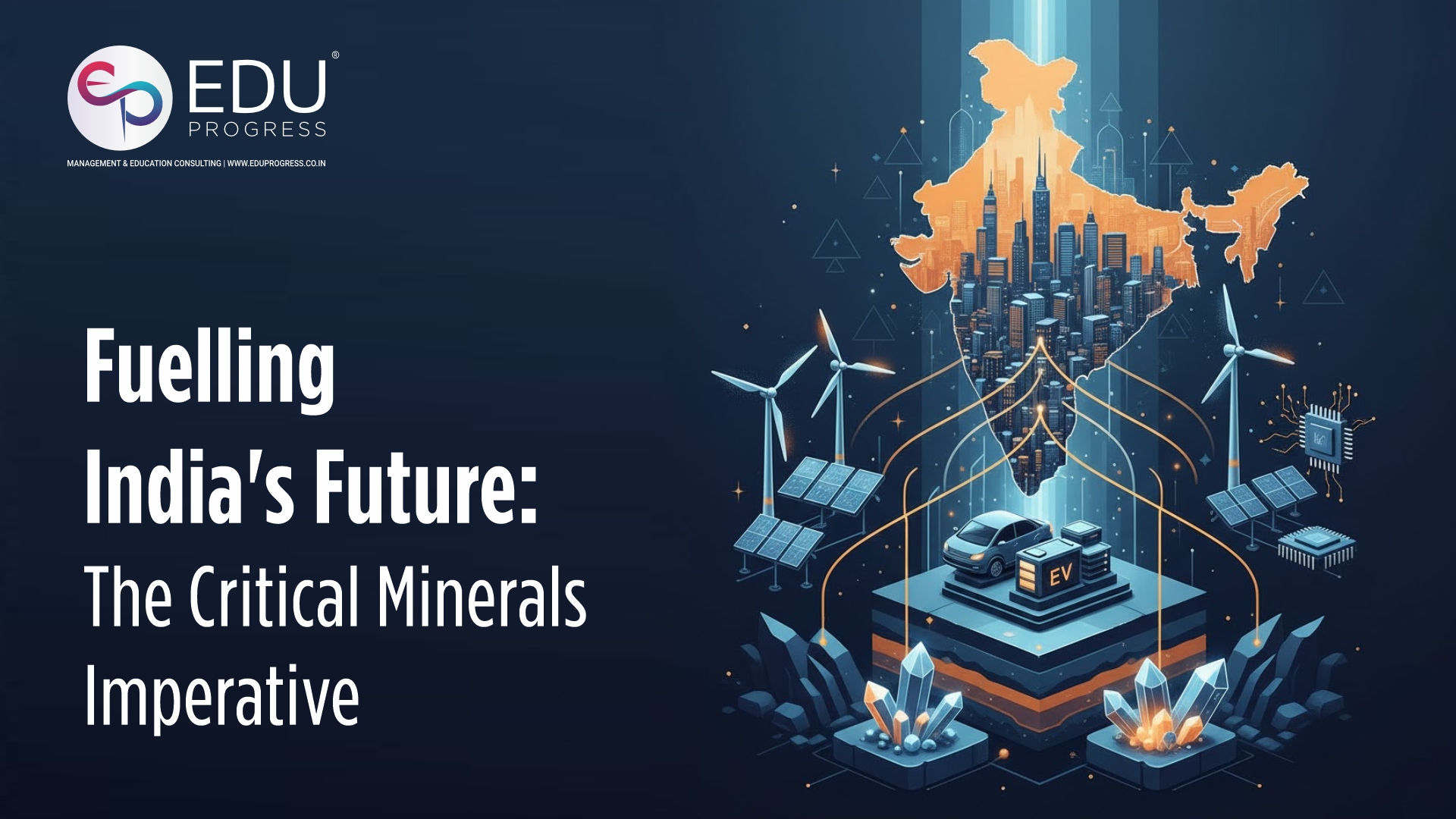
Fuelling India’s Future: The Critical Minerals Imperative
The invisible cornerstone of the economy of the twenty-first century is critical minerals. Every modern industry, including wind turbines, electronics, and EV batteries, depends on essential minerals. India’s ability to protect, preserve, and grow vital minerals, which are currently in short supply domestically but are essential for every contemporary industry, from electronics and renewable energy to defence and space, will now determine how rapidly the nation can fuel its future.
Critical Minerals: At the Heart of Global Power and Geopolitics
Critical minerals, formerly a niche concern, are now crucial for both geopolitical and economic security globally. Major economies have invested major investments in preserving supply chains that support future technologies, from electronics and renewable energy to military and space, because mining and processing are concentrated in just a couple of nations.
This global trend strengthens the urgency for India. Strong reliance on imports exposes India’s energy transformation and Aatmanirbhar Bharat objectives to market and geopolitical dangers, but it also offers a chance for India to become a dependable, strategic participant in the vital minerals value chain.
The Crucial Role of Critical Minerals in India’s Growth
Critical minerals are resources that are essential to India’s economic objectives yet are liable to interruption in supply. Thirty minerals, including lithium, cobalt, nickel, graphite, and rare earth elements, have been selected by the Ministry of Mines as being essential to India’s future development.
The impact of these minerals on India’s upcoming years of growth can be summarised across three pillars:
1. Green Energy Transition:
India is committed to achieving Net-Zero emissions by 2070 and sourcing 50% of its electric power capacity from non-fossil fuel sources by 2030. This transition is critically dependent on:
- Electric Mobility: Lithium, Nickel, and Cobalt are key components of Li-ion batteries for EVs.
- Renewable Energy: Rare earth elements like Neodymium and Dysprosium are essential for the powerful magnets in wind turbines, while Silicon, Indium, and Gallium are crucial for high-efficiency solar panels.
2. Strategic & High-Tech Industries:
Critical minerals are the building blocks for advanced sectors like defence, aerospace, and electronics. Secure access is vital for enhancing national security and developing indigenous technological capabilities under the ‘Aatmanirbhar Bharat’ vision.
3. Economic Competitiveness and Stability:
Securing domestic and international supplies will de-risk manufacturing, boost domestic value addition, and enhance India’s global competitiveness.
India’s Two-Pronged Strategic Roadmap for Self-Reliance
India is pursuing self-reliance in critical minerals through a strategic two-pronged approach, strengthening domestic capabilities while securing global partnerships to address supply realities.
1. Strengthening Domestic Capabilities: Boosting Homegrown Capacity
The National Critical Mineral Mission (NCMM), which was announced in 2025, is the cornerstone of the Government of India’s comprehensive, multifaceted effort to increase domestic capacity in key minerals.
- Progressive Legislative Framework: The Mines and Minerals (Development and Regulation) Amendment Act, 2023 transformed India’s mining sector by delisting 24 critical minerals, enabling central auctions and greater private participation, leading to India’s first-ever e-auction of critical mineral blocks in 2023.
- Accelerated Exploration Initiatives: The Geological Survey of India has intensified exploration with over 1,200 projects planned by 2030–31, already identifying promising lithium deposits in Jammu & Kashmir and Rajasthan, signalling India’s growing critical mineral potential.
- Circular Economy and Resource Recovery: India’s focus on urban mining, recovering critical minerals from e-waste and end-of-life batteries, offers a sustainable alternative to imports while addressing the country’s growing e-waste challenge through advanced recycling and recovery systems.
2. Strategic International Engagement: Securing International Assets
Understanding that complete self-sufficiency in all critical minerals is neither practical nor necessary, India has proactively developed a strategy to secure international mineral assets and build resilient global supply chains.
i. KABIL: India’s Overseas Mineral Acquisition Arm: Khanij Bidesh India Limited (KABIL) has been created to secure overseas critical mineral assets, focusing on lithium, cobalt, and nickel in resource-rich countries such as Australia, Argentina, and Chile to ensure long-term supply security for India.
ii. Building Global Partnerships: India is actively engaging with the international community to create diversified, resilient supply chains. Key initiatives include:
- Minerals Security Partnership (MSP): India’s participation in this international coalition brings together like-minded nations committed to strengthening critical mineral supply chains and reducing dependence on single-source suppliers.
- Bilateral Agreements: India is forging strategic bilateral partnerships with allied nations, creating frameworks for long-term cooperation, technology transfer, and mutual investment in critical mineral projects.
Transforming India’s Position: From Dependency to Global Leadership
The ultimate objective is to transform the nation from a reliant consumer to an independent global hub for the whole essential mineral value chain, from mining and exploration to processing, manufacturing, and recycling. This is essential to the country’s objective of developing into a developed nation (Viksit Bharat).
Centres of Excellence: Building India’s Technological Foundation
The creation of specialised Centres of Excellence (CoE) for Critical Minerals is a fundamental component of the NCMM. These CoEs, which use a hub-and-spoke model, integrate academic institutions, R&D centres, and business partners to advance the country’s technological capabilities in this crucial field. The CoEs’ primary mandates:
- Advancing Research and Innovation: The CoEs are charged with conducting cutting-edge research to achieve higher Technology Readiness Levels (TRL) across the critical minerals value chain, focusing on:
- Extraction and Beneficiation: Improving the process of extracting critical minerals from low-grade ores and unconventional sources.
- Processing and Refining: Developing advanced metallurgical processes to refine raw minerals to the high-purity standards required for manufacturing advanced technologies like battery cathodes.
- Recycling: Innovating cost-effective methods for recovering valuable critical minerals from end-of-life products.
- Building Skilled Workforce: The CoEs serve as vital training grounds for developing highly skilled professionals, bridging the critical gap between laboratory research and commercial-scale deployment in complex mining and refining operations.
By leveraging the capabilities of these CoEs, India aims to reduce its technological dependency on foreign players and secure strategic autonomy in the processing and manufacturing of critical mineral-based products.
Eduprogress: Enabling Institutions to Lead India’s Mineral Future
Translating national missions into institutional capability requires deep domain understanding, ecosystem design, and execution expertise. This is where Eduprogress plays a critical role.
Eduprogress works with institutions and universities to conceptualise, structure, and operationalise Centres of Excellence in mining and critical minerals, aligned with government missions such as NCMM. Through research-driven strategy, Eduprogress bridges policy, academia, and industry, enabling institutions to actively support India’s shift from mineral dependence to leadership.
Beyond infrastructure and strategy, Eduprogress supports training and development programs, from executive education and faculty development to industry-oriented skill programs, ensuring that talent development keeps pace with India’s mineral ambitions.
