Introduction
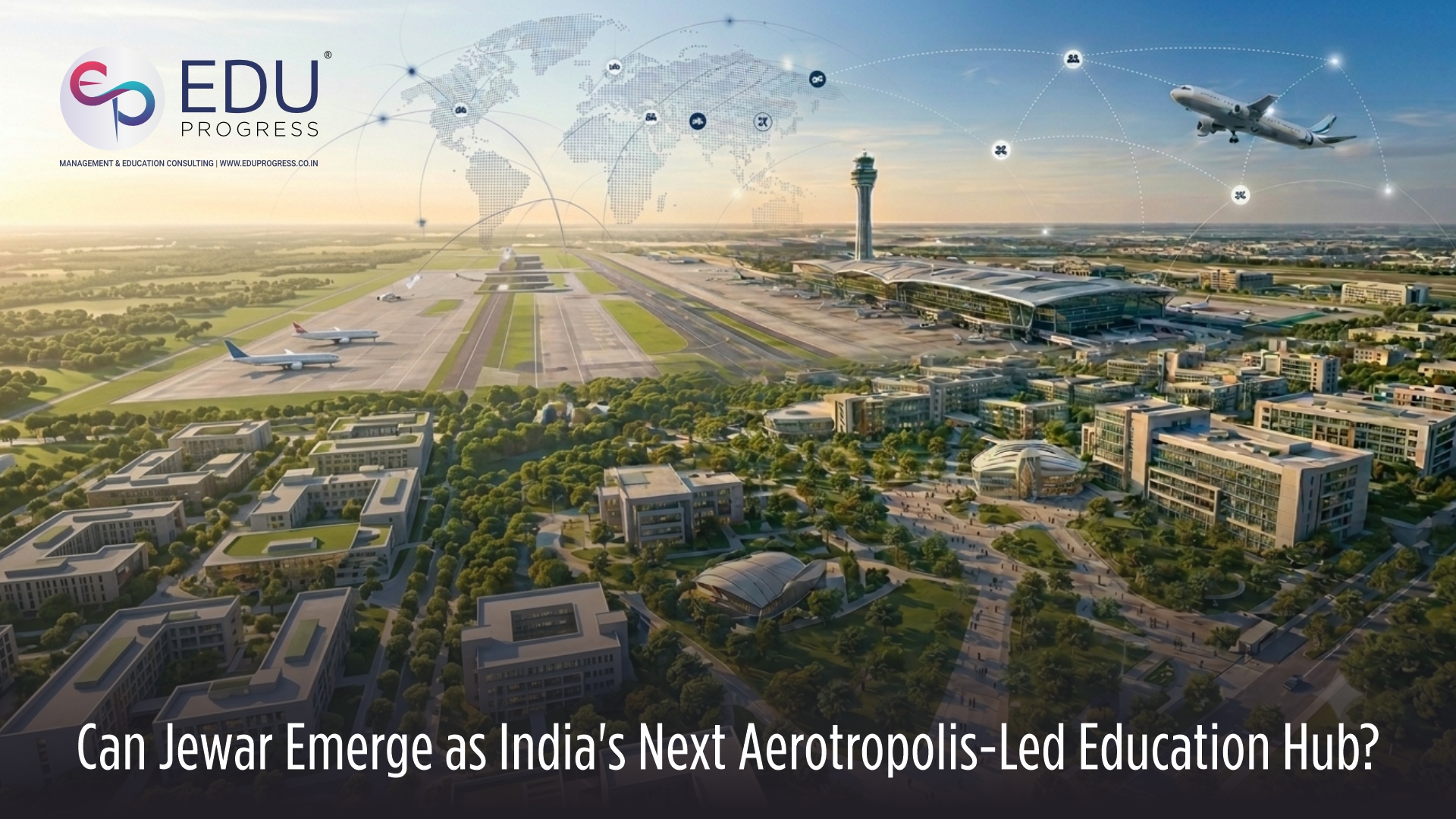
Jewar, located in Uttar Pradesh’s Buland Shahr district, is rapidly transforming from an agricultural region into a high-growth economic corridor driven by the development of the Noida International Airport. As airport-led urbanization accelerates, the region is witnessing growing opportunities beyond infrastructure, including higher education and skill development.
With improved connectivity, expanding employment zones, and planned developments such as private and international universities, industry clusters, and the proposed film city, Jewar is emerging as a potential destination for integrated learning and workforce development.
Past and Current Education Infrastructure
Historically, Jewar was a predominantly rural, agriculture-based region with limited formal education infrastructure. While basic schooling was available through government schools, access to higher education remained a challenge, forcing many students particularly women to either discontinue their studies or travel to Bulandshahr and nearby cities.
A major turning point came with the establishment of Rajkiya Mahavidyalaya, Jewar’s first co-educational degree college affiliated with CCSU, Meerut, creating local access to higher education. The subsequent approval of a women’s degree college by the state government further expanded educational opportunities and strengthened the region’s evolving higher education ecosystem.
Opportunities for Higher Education
1. Aviation and Airport-Based Education
The primary growth catalyst for Jewar is the development of Noida International Airport. As stated by the Hon’ble Chief Minister of Uttar Pradesh, the airport is expected to be among the largest in India. Beyond creating opportunities in aviation, the project is expected to stimulate demand across an extensive ecosystem of skilled professionals.
Airports generate employment across technical, managerial, operational, logistics, hospitality, and service-related functions. Educational institutions can capitalize on this demand by introducing specialized undergraduate, postgraduate, diploma, and executive education programs aligned with industry requirements.
Opportunity areas:
- Aviation Management
- Airport Operations
- Aircraft Maintenance Engineering
- Air Cargo Management
- Ground Handling
- Cabin Crew Training
- Airport Safety and Security
- Aviation Analytics
2. Development of a New Knowledge and Education Corridor
Jewar is becoming an integrated economic and institutional growth zone centered around Noida International Airport. The broader vision extends beyond aviation to create a hub for education and industry-led development.
This creates opportunities for:
- New private and multidisciplinary universities
- International university campuses and collaborations
- Specialized institutes for aviation, technology, and hospitality
- Integrated education ecosystems linked with industry
Unlike mature urban centers with land constraints, Jewar offers relatively large land parcels that support residential campuses, innovation districts, industry–academia collaboration, and long-term expansion.
Institutional interest is already emerging: Internationally, Lincoln University Malaysia has shown interest in establishing a campus near the airport corridor. On the national side, groups such as Management Development Institute (MDI), Sharda Group, and Savita Educational Group have explored expansion opportunities in the Yamuna Expressway in Jewar region.
3. Technology and Future Skills Education
As infrastructure and economic activity continue to expand around Jewar, educational demand is expected to shift toward future-oriented and technology-led disciplines.
High-growth academic areas include:
- Artificial Intelligence (AI)
- Data Science
- Machine Learning
- Cybersecurity
- Robotics
- Cloud Computing
- Smart Infrastructure
- Digital Transformation
Educational institutions that establish technology-focused schools and interdisciplinary programs can attract both local and national student demand. The region is also witnessing growing international academic interest. Western Sydney University has announced plans to establish its presence in the Greater Noida region, offering programs in Artificial Intelligence, Machine Learning, and Data Science.
4. Healthcare and Allied Health Education
Rapid population growth and urban expansion around Jewar are expected to drive increasing demand for healthcare services and healthcare professionals.
Key educational segments include:
- Medical Sciences
- Nursing
- Physiotherapy
- Public Health
- Healthcare Management
- Allied Health Programs
Institutions that establish integrated healthcare campuses with teaching hospitals, clinical training centers, and industry partnerships are likely to gain long-term advantages while supporting the region’s expanding healthcare needs.
5. Research, Innovation and Entrepreneurship Ecosystem
Modern universities are increasingly evolving beyond teaching institutions to become centers of innovation, entrepreneurship, research, and industry engagement.
Key opportunity areas include:
- Incubation and entrepreneurship centers
- Startup accelerators
- Applied and industry-led research
- Industry–academia collaboration
- Technology transfer and commercialization
The emergence of initiatives such as planned technology and innovation hubs, electronics manufacturing clusters, and investment-led industrial development creates favorable conditions for universities to anchor research ecosystems, foster startups, and build strong industry partnerships.
6. Affordable and Accessible Higher Education for Local Students
Historically, students from Jewar and nearby areas have depended on larger urban centers such as Noida, Greater Noida, Delhi, and Aligarh to pursue higher education due to limited local institutional availability.
Jewar Tehsil had a population of over 2.21 lakh as per Census 2011 and is projected to continue growing as airport-led urban development accelerates. The region also recorded a literacy rate below the district average, highlighting the need for stronger local educational infrastructure.
Potential institutional models include:
- Degree colleges
- Community colleges
- Skill universities
- Hybrid and technology-enabled education centers
Expanding higher education capacity within the region can reduce outward student migration, improve participation in tertiary education, and strengthen local human capital development.
BCG Strategic Analysis: Jewar as an Education Hub
Jewar is positioned as a Star in the BCG framework—characterized by very high market growth and an emerging but building market share.
BCG Matrix: Jewar Education Hub Positioning
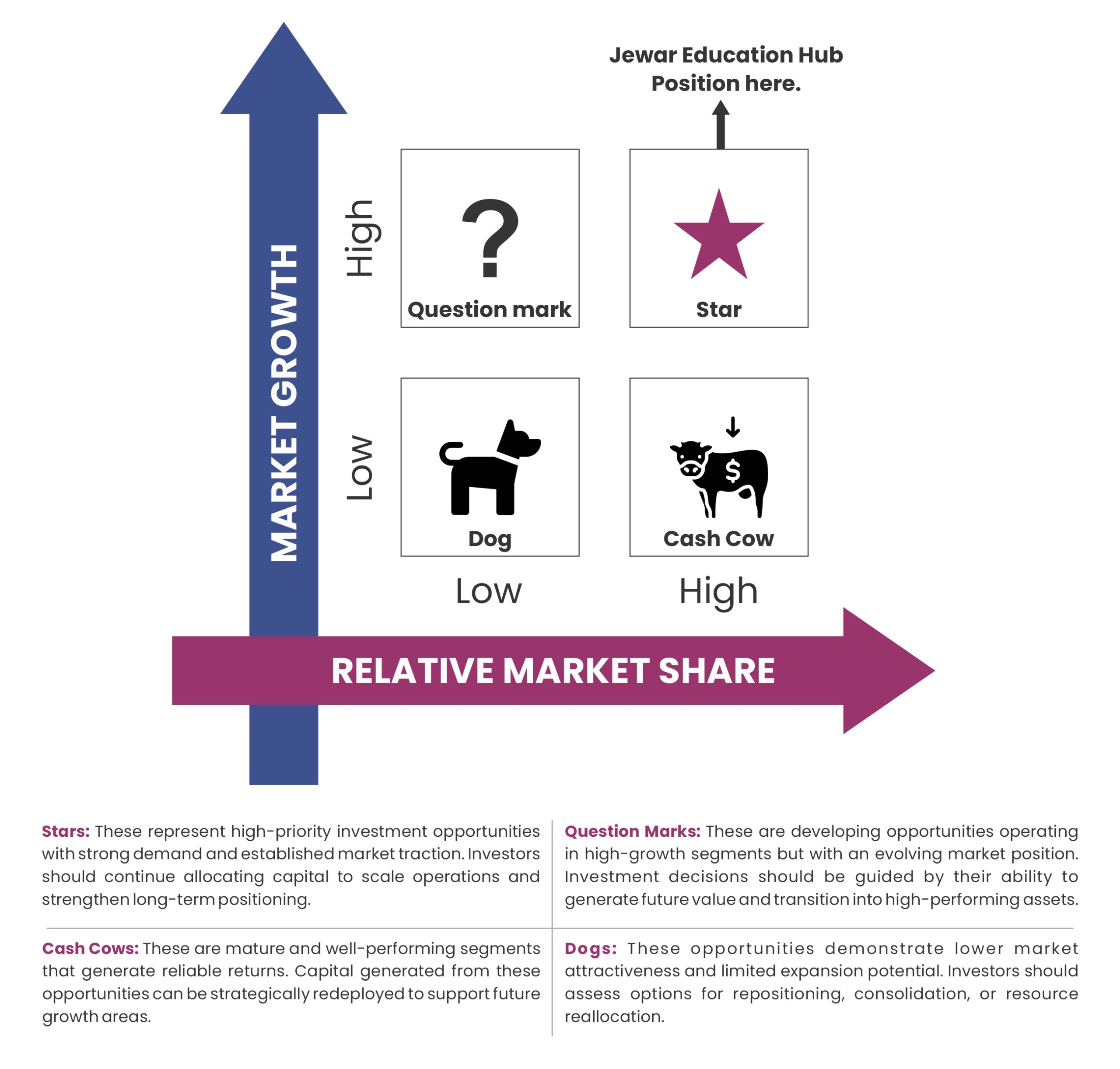
| Market Growth Rate | Very High | ↑ High Growth | Driven by airport operationalization, government investment, FDI from international universities, and NCR proximity enabling 50M+ population access |
| Relative Market Share | Emerging / Building | → Building Share | Strong private investment pipeline (Lincoln, Tata) and upgraded school infrastructure, but constrained by limited faculty capacity, small program portfolio, and emerging brand recognition |
| Final Position | STAR | High Growth + Building Share | Requires aggressive investment in academic capability, faculty hiring, program accreditation, and industry-integrated curricula to secure defensible market leadership |
Growth Drivers: The region’s trajectory is powered by the operational Noida International Airport, significant government and international investment, and strategic proximity to the NCR’s massive population base. These factors create immediate demand for specialized education across aviation, technology, healthcare, and industry-linked skill programs.
Market Share Dynamics: While growth is robust, Jewar’s relative market share remains in a development phase. The region has secured a strong private investment pipeline—including confirmed commitments from Lincoln University Malaysia, Galgotias, and Tata—alongside upgraded school infrastructure and planned industry partnerships. However, foundational constraints persist: limited faculty capacity, a small portfolio of academic programs, and emerging brand recognition.
Strategic Implication: Jewar’s Star position demands aggressive investment in academic capability, faculty hiring, program accreditation, and industry-integrated curricula. Capitalizing on this window will allow institutions to establish defensible market leadership before competition intensifies as the aerotropolis corridor matures.
Conclusion
Jewar is emerging as a promising education and knowledge hub driven by the development of Noida International Airport and rapid regional growth. Expanding infrastructure, industry, and urbanization are creating opportunities across aviation, technology, healthcare, research, and skill-based education. Growing interest from national and international institutions highlights the region’s long-term potential. Improved local access to quality higher education can reduce student migration and strengthen regional workforce development. With strategic investment and industry integration, Jewar has the potential to become a leading higher education destination within NCR.
About Eduprogress
Eduprogress & Research Pvt. Ltd. is a leading higher education consultancy committed to shaping the future of higher education in India. With deep expertise in university establishment, institutional transformation, regulatory compliance, academic planning, governance frameworks and strategic growth, Eduprogress provides comprehensive support from concept to commissioning for any brownfield or greenfield projects. As a trusted partner to educational trusts, societies, philanthropic organizations, corporate foundations, government-supported entities, and university promoters, Eduprogress has been instrumental in enabling institutions to achieve their vision of academic excellence, institutional autonomy, and long-term sustainability by establishing state private university, on deemed to be university. .
As Jewar positions itself as an emerging aerotropolis-led education hub, Eduprogress offers end-to-end support for educational institutions looking to establish or expand operations in the region. It delivers strategic insight and implementation support to build a sustainable, globally competitive education ecosystem.
Bibliography
- Census of India 2011 – censusindia.gov.in
- Noida International Airport – noidainternationalairport.com
- Government of Uttar Pradesh Higher Education Department – highereducation.up.gov.in
- Chaudhary Charan Singh University – ccsuniversity.ac.in
- YEIDA – yamunaexpresswayauthority.com
- Lincoln University College Malaysia – lincoln.edu.my
- Sharda University – sharda.ac.in
- MDI Gurgaon – mdi.ac.in
